Engine design, components, and Papervision3D
Trent Sterling's 2011 ActionScript game-engine experiments: composition over inheritance, FlashPunk-inspired components, Papervision3D culling and performance.
So I just got finished implementing components to replace my inheritance based entity system. Getting used to factories and pooling has been a bit of a battle, but I feel as though I’m ready to start actual game production. My engine has fake lighting, which adds another draw call, and it slows things down a bit. Typically you can get away with 1000-1500 triangles in a Papervision3D scene without worrying about the CPU melting, but I’ve limited my game scenes to around 500 triangles, which is 250 quads or 40-ish cubes.
Luckily culling can smooth out those numbers a bit and I can get away with more. The entire engine will have a hard focus on culling triangles from the viewport, and culling objects in general. By removing physics bodies and making models invisible at a distance, I can have many objects in a level. It’s all about effective culling and sparse distribution of objects. Also, I can focus on designing good looking levels with many static objects, as they aren’t as resource intensive as dynamic moving objects.
Speaking of CPU usage and lighting, here’s an image I just took showing 100 GameObjects with several components attached. The draw function is called twice, once with a normal blendmode, and again with the multiply blendmode (lighting). Surprisingly the CPU usage isn’t too high, but then again, I’m on a 2.4GHz quadcore. I want my game to be playable on a netbook, even if it does drain the battery a bit. I haven’t decided if I want to go to 30FPS. It would cut my CPU usage down in half, but I feel like 30FPS is choppy!
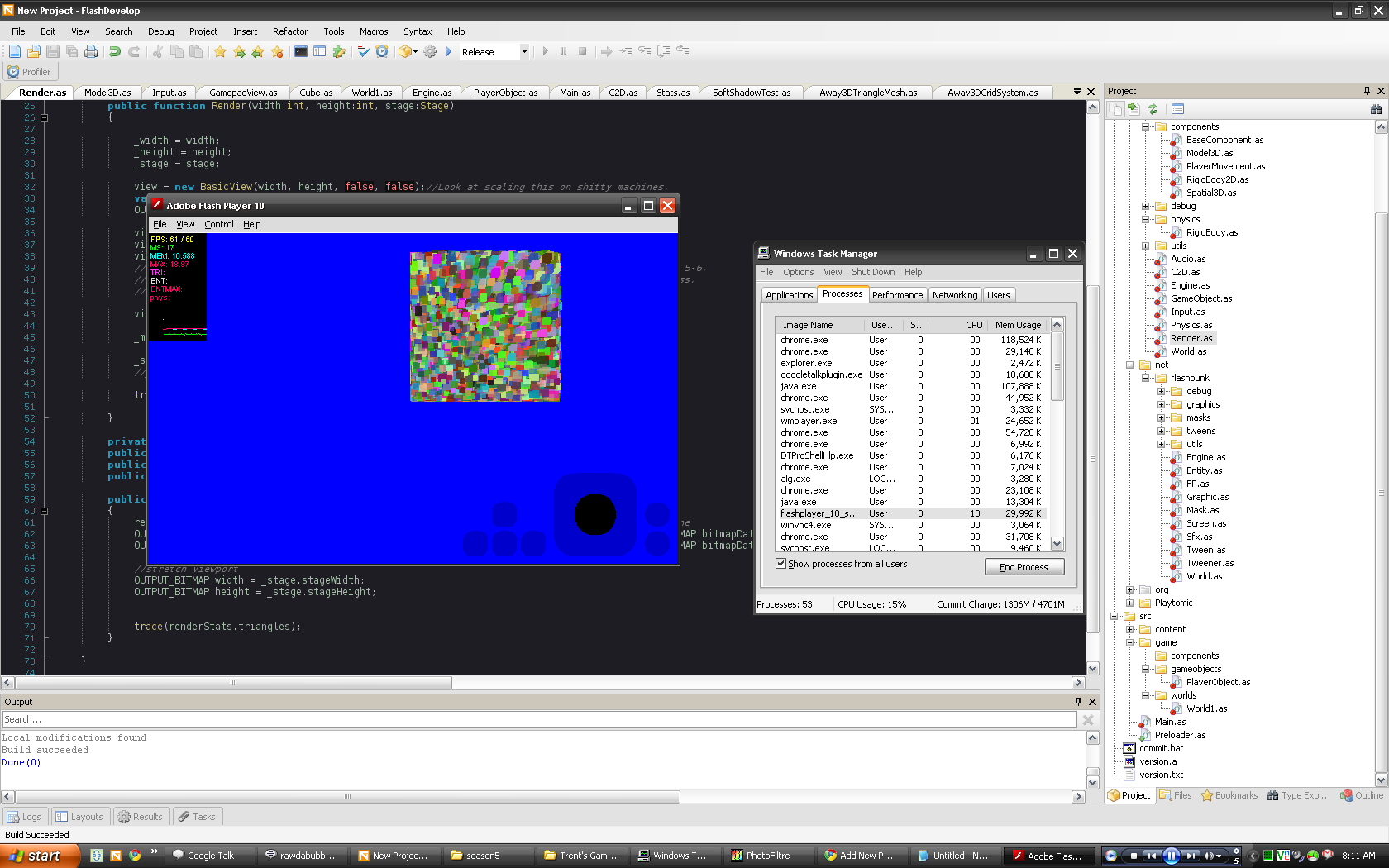 Drawing cubes
Anyway, now that I have fairly quick rendering, and a component based architecture, I feel that it’s time for me to get some interactive-ness back into my game. This is probably the 6th iteration of my engine. I have rebuilt it so many times that it isn’t the same thing anymore. It’s something smarter…faster…awesome..er!
EDIT: As you can see from the image above, I’ve stolen my naming conventions from FlashPunk. Before I had a much crazier folder/class structure.
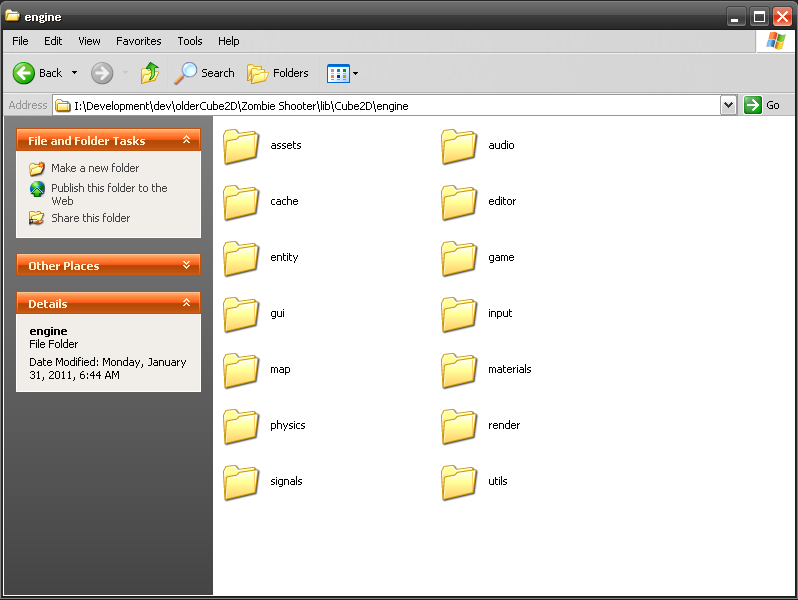 Invincible structure, or too complicated?
I felt as though this set up was the best, but then I saw the simplicity in FlashPunk.
Archive context (2026)
The original article is unusually specific about its rendering budget. It describes replacing an inheritance-heavy entity system with components, factories, and pooling, then limiting a Papervision3D scene to roughly 500 triangles as a conservative target. It discusses hiding distant models and physics bodies, a second rendering pass for fake lighting, and the tradeoff between 30 FPS and responsiveness on low-powered machines.
The screenshots support that account: one shows a FlashDevelop project with ActionScript component, physics, and rendering files beside a colorful cube stress test and Windows Task Manager; another shows the sprawling folder structure of an earlier engine. The screenshots demonstrate the development setup and prototype tools, not a formally repeatable performance benchmark.
Looking back (editorial)
There is a recognizable engineering instinct here: make a system extensible, then make sure it can actually run on modest hardware. In 2011 the target was something as constrained as a netbook, not a modern VR headset. The hardware has changed dramatically, but the tension between ambitious simulation and a hard frame budget is already explicit. The earlier 3D Rendering in Flash entry shows the renderer-selection side of the same work.